
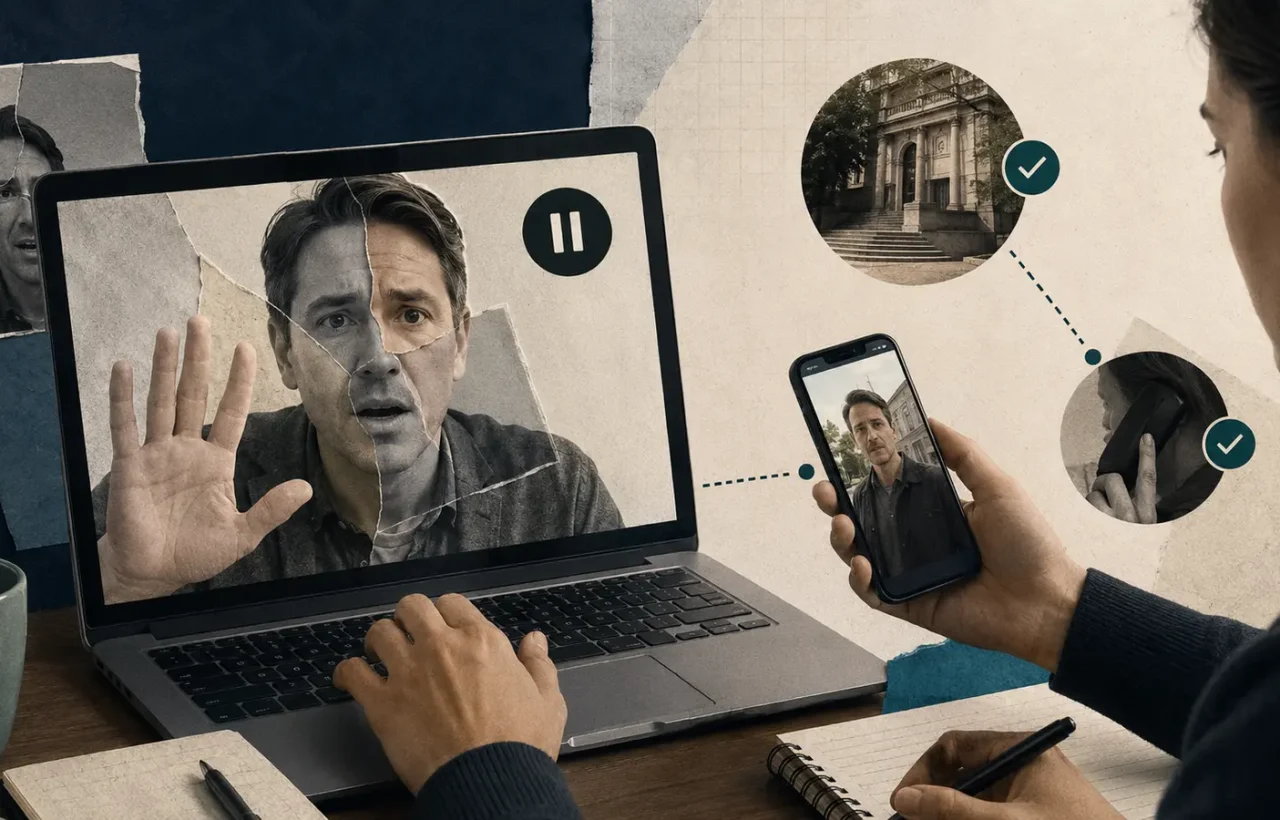
A few years ago, an awkward blink or poorly matched lips could give away a manipulated video. Those clues are no longer dependable. A convincing deepfake can survive a quick visual check, and a criminal rarely needs a flawless film. A short, noisy call in a familiar voice may be enough to make someone act before thinking.
Spotting deepfakes is therefore not a hunt for one magic pixel-level defect. A more durable defence has three parts: examine the circumstances, verify the claim through an independent channel, and refuse to take an irreversible action under pressure.
Check the story before the pixels
Start with the practical question: what does the sender want you to do? Risky messages commonly lead toward a payment, a one-time code, a downloaded file, a sudden change of bank details, or the rapid sharing of a sensational clip. Fear, sympathy, authority and easy profit are used to shorten the time available for verification.
Be particularly careful when the caller or sender:
- tells you not to contact anyone else;
- asks for gift cards, cryptocurrency or a transfer to a new account;
- blames strange speech on a bad connection and avoids specific questions;
- provides only a short extract with no original context;
- insists the decision must be made immediately.
None of these details proves that AI generated the media. They do establish that the requested action needs separate confirmation, even if the face and voice look authentic.
Visual and audio clues that can still help
Watch a suspicious video twice: once at normal speed and once more slowly. Look for unstable boundaries around hair or glasses, odd interaction between fingers and the face, teeth that change shape, inconsistent reflections, and lighting that does not fit the room. During a live call, ask the person to turn their head, move a hand in front of their face or change the light. This is not a conclusive test, but it may expose an unstable real-time replacement.
With audio, listen beyond the voice’s basic tone. Unusual pacing, repeated intonation, misplaced pauses, missing breaths and unfamiliar pronunciation of names can be useful prompts to verify. Messaging compression and a poor microphone can produce similar artefacts, however, so audio alone is not a fair reason to accuse somebody.
Standalone “AI detectors” should not be treated as judges either. Results vary with the generation model, editing, resizing and file quality. An 80 percent score remains a probabilistic output, not proof of authorship.
Independent contact is the strongest test
If a relative calls asking for emergency money, end the call and ring a number already stored in your contacts. Do not use a number supplied in the new message. If a supposed executive requests a bank-detail change, confirm it through the established company chat or another colleague authorised to approve payments.
Families can agree on a private verification phrase that cannot be found in public profiles. It should not be a pet’s name, birthday or address. For business payments, a formal process works better: every change of account details requires a call to a known number and approval from a second person.
For public media, trace the original. Check the official website or verified channel, look for the full recording and find independent reporting. A reverse search of a representative frame may uncover an old video fitted with new audio. Provenance records such as Content Credentials can add useful context when present, but their absence does not automatically make a file fake.
If you have already responded
If money has been sent, contact the bank or payment provider immediately and ask whether the transaction can be stopped. If a password or verification code was disclosed, change the password from a trusted device, terminate existing sessions and enable strong multifactor protection. Preserve the number, conversation, wallet address, timestamps and original file; these details may help a security team or law enforcement.
Avoid re-uploading a suspicious clip merely to label it false. Copies give the material more reach and may separate it from the correction. Use the platform’s reporting function and notify the impersonated person or organisation through an official route.
A short protocol for an urgent call
- Do not transfer money or reveal codes during the conversation.
- Ask for a detail the real person can answer but that is not public online.
- End the contact yourself.
- Call back through a known route or involve a second responsible person.
- Act only after the request has been confirmed.
Generative systems will evolve faster than lists of visual glitches. An independent verification process ages more slowly. Whenever a message asks for money, secrets or an immediate decision, a two-minute pause matters more than an ability to spot the wrong shadow.



Join the conversation
Stay on topic and respect other readers. Your first comment may appear after editorial review.