
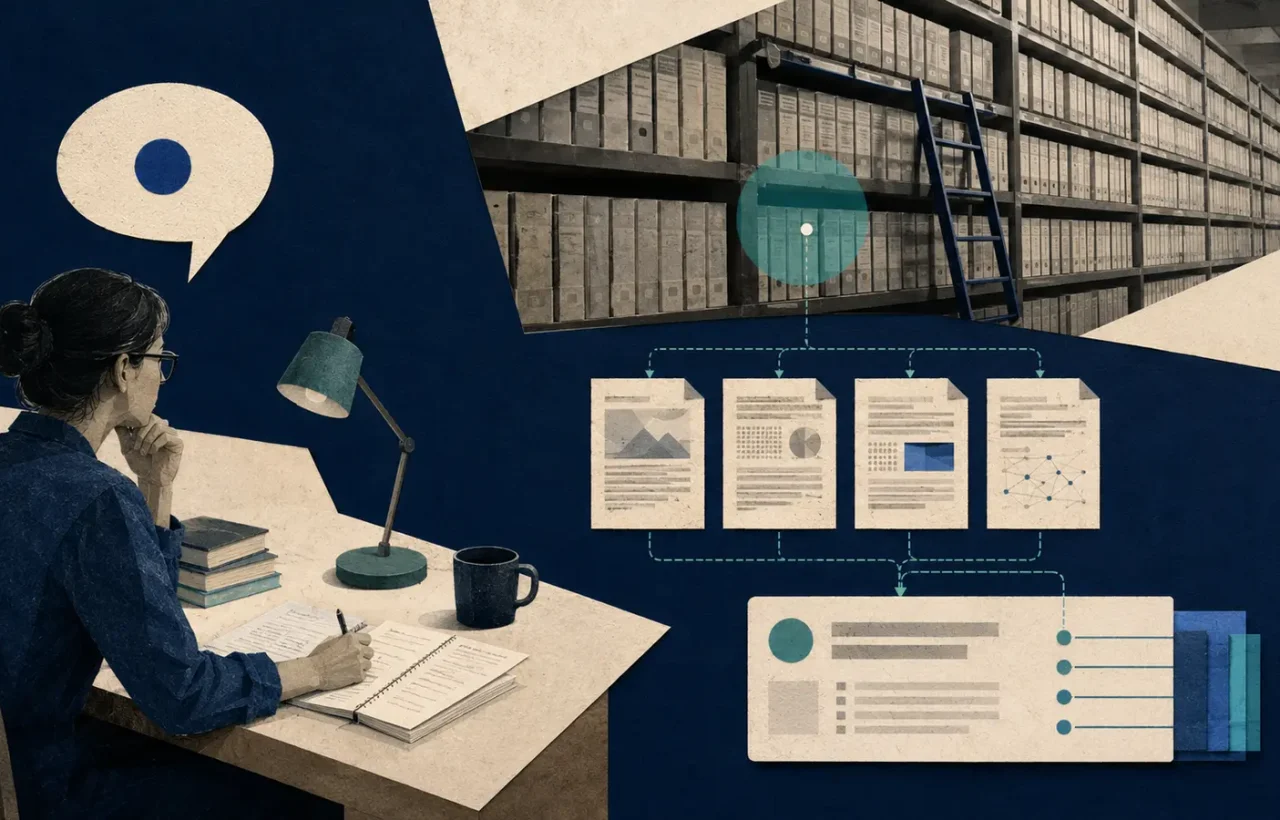
Retrieval-augmented generation, usually shortened to RAG, is a way to give a language model selected information at the moment it answers. Instead of expecting the model to know a company handbook, a product manual, or your research archive from training, the system searches an approved collection, retrieves relevant passages, and places them in the prompt as context.
RAG can make answers more specific and easier to verify. It does not guarantee truth. A search step can retrieve the wrong passage, omit an exception, or return an outdated document. The model can still misunderstand good evidence. The useful question is not “Does this product have RAG?” but “Which sources were searched, what was retrieved, and can I inspect it?”
The basic RAG pipeline
A simple implementation has two phases. First, documents are prepared for search. Later, the system retrieves context for each question.
During preparation, files are extracted into text, divided into chunks, labeled with metadata, and indexed. Many systems create embeddings: numeric representations that help find passages with similar meaning even when the words differ. A manual that says “terminate the subscription” may still match a question about “canceling an account.”
When a user asks a question, the system:
- converts or analyzes the query;
- searches the index;
- chooses several passages;
- adds those passages and instructions to the model context;
- generates an answer, often with links or citations.
The model is not retrained for every new PDF. The source is supplied at answer time. That distinction makes RAG practical for information that changes frequently or belongs to one organization.
Why chunking matters
A document is rarely indexed as one enormous block. It is divided because retrieval works better when each result contains a focused idea. But chunk boundaries create tradeoffs. Tiny chunks may lose definitions or exceptions. Huge chunks add irrelevant text and can bury the important sentence.
Good chunking follows the document’s structure where possible: headings, sections, table rows, or complete policy clauses. Metadata should preserve the title, version, owner, date, language, permissions, and a link to the original. A retrieved paragraph without its date can be actively misleading when two versions of a policy exist.
Tables, scanned PDFs, footnotes, and diagrams need special care. If extraction loses a column or page label, the retrieval layer cannot recover the meaning. Test representative documents before importing an entire archive.
Semantic search is not magic
Keyword search is precise when the user knows the official term. Semantic search is useful when the wording differs. Many systems combine both, then rerank the candidates. The exact method matters less to an editor than the test: do realistic questions retrieve the passages a knowledgeable person would use?
Create a small evaluation set with questions, expected sources, and unacceptable sources. Include ambiguous queries and questions whose correct answer is “the collection does not contain enough information.” A RAG system should be allowed to abstain.
Citations help only when they are real
A citation should point to the exact source used, not merely a plausible page. The interface should let the reader open the passage in context. If the model generates citation numbers on its own, it may attach a correct-looking marker to an unrelated statement.
Check three layers separately:
- retrieval: did the system find the right document and section?
- grounding: does the answer actually follow from those passages?
- presentation: do links, titles, dates, and quotations match the original?
This separation makes debugging much faster. If retrieval failed, rewriting the final prompt will not fix missing evidence.
Permissions are part of retrieval
An internal knowledge assistant must not retrieve a confidential salary file for someone who cannot open the original. Access control should be applied before passages enter the model context, not only hidden in the interface afterward.
Respect deletion and retention too. Removing a source file should remove its chunks and derived index entries. If a service stores prompts, retrieved passages, or logs with an external model provider, that data flow belongs in the privacy and vendor review.
For sensitive work, ask where the index runs, how documents are encrypted, whether content trains shared models, who can export logs, and how quickly deleted data disappears from backups.
Common failure modes
RAG systems often fail in ordinary, fixable ways:
- An old policy ranks above the current one because versions lack metadata.
- The answer combines two individually correct passages that apply to different products.
- A table is extracted in the wrong reading order.
- The right document is found, but the chunk omits a decisive footnote.
- Retrieval returns many weak matches, and the model fills the gap with prior knowledge.
- The user asks for a conclusion that the sources do not support.
Instructions should require the model to distinguish sourced facts from general explanation and say when evidence is insufficient. A confidence label generated by the same model is not a substitute for checking the passage.
When RAG is a good fit
RAG is useful for product documentation, policies, research libraries, support knowledge, contracts with permission controls, and any collection that changes more often than a model is retrained. It is less helpful when the task depends on a small structured database that should be queried directly, or when precise calculations are better handled by code.
Do not use RAG to disguise poor information management. Duplicate files, missing owners, vague titles, and contradictory policies will become retrieval problems. Clean the collection, identify an authoritative version, and define who maintains it.
A small, dependable pilot
Choose one narrow collection and twenty to fifty real questions. Record the expected source for each question. Add permission cases, outdated documents, and several questions that should receive no answer. Measure source retrieval before judging prose quality.
Then show citations by default, include a feedback route, and review failed questions weekly. Only expand the corpus after the first collection is reliable. If you are building the underlying notes and source library from scratch, start with our guide to a personal knowledge base with AI.
RAG is valuable because it narrows a model’s attention to evidence you control. Its quality comes from document hygiene, retrieval tests, permissions, and honest uncertainty—not from attaching a search box to a chatbot.




Join the conversation
Stay on topic and respect other readers. Your first comment may appear after editorial review.