
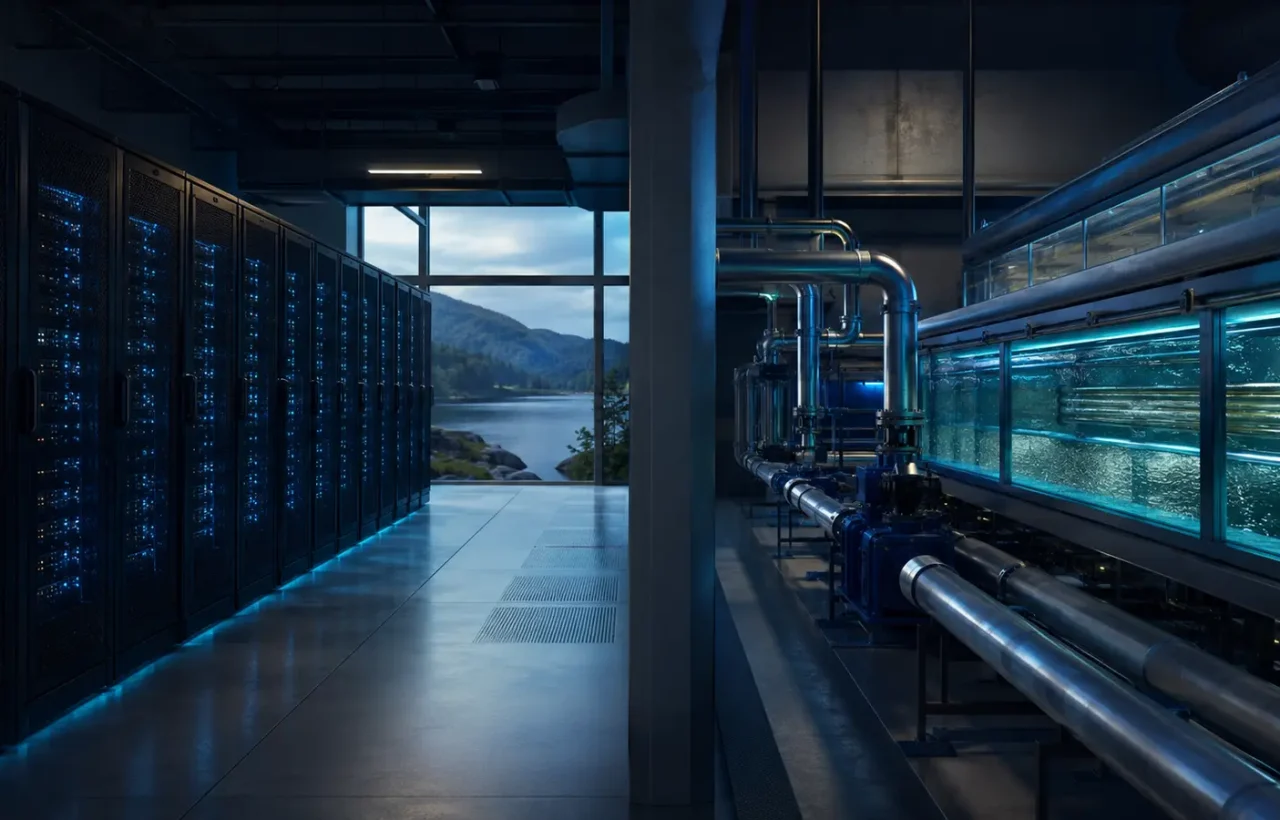
Servers do not need water to perform calculations. Water enters the picture during cooling: almost all the electricity consumed by IT equipment eventually becomes heat, and that heat must be removed continuously to keep the equipment within a safe operating range.
Data center water consumption is often reduced to one large annual figure or a striking comparison with a bottle of water. Neither tells the whole story. The effect depends on the kind of water a facility uses, where it is located, what happens during hot weather, and whether the water returns to the same watershed.
Where does a data center use water?
Some data centers reject heat through evaporative cooling. Water evaporates in a cooling tower or similar heat-exchange system and carries heat away with it. This approach can require less electricity than running compressor-based chillers continuously, but the evaporated water does not return to the local system in liquid form.
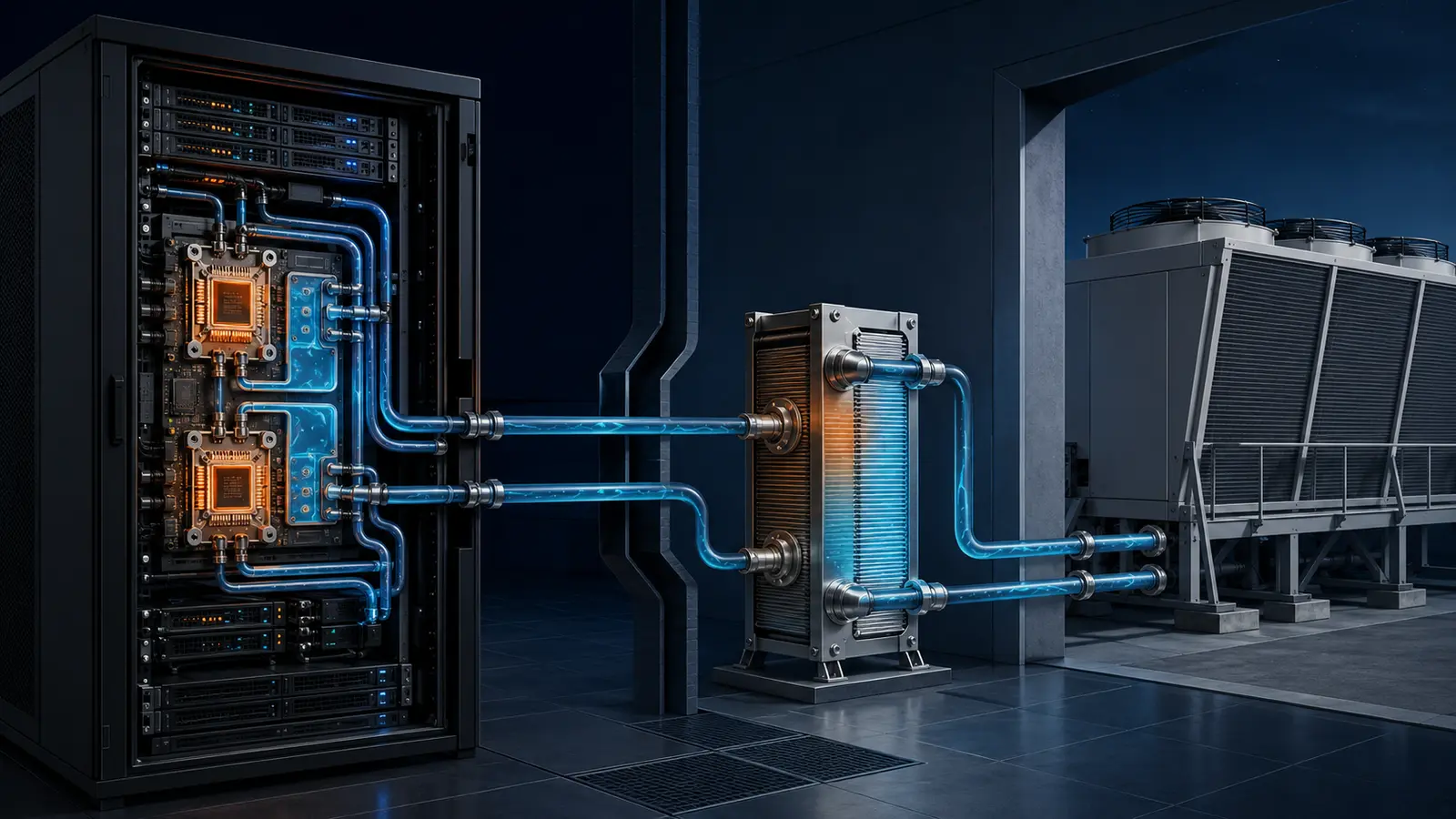
Liquid cooling at the server does not automatically mean heavy fresh-water use. In a direct-to-chip system, coolant circulates through small tubes near the processors. With immersion cooling, the hardware operates in a dielectric fluid. Both can use closed loops with limited losses.
The decisive question is where that loop sends the heat next. If a dry radiator releases it to the outside air, direct water consumption can be very low. If the final stage is still an evaporative cooling tower, the facility continues to consume water.
There is also an indirect footprint. Some forms of electricity generation use water, particularly for cooling thermal and nuclear power plants. A data center without a cooling tower on its roof is therefore not necessarily “water-free.” Part of its footprint may occur elsewhere in the power system.
Water withdrawal and consumption are not the same
Water withdrawal is the volume taken from a river, well, reservoir, or municipal network. Some of that water may be treated and returned. Water consumption usually refers to water that does not return to the same local source in an available form, most often because it has evaporated.
This is why two large figures in sustainability reports may describe different things. A high withdrawal followed by discharge is not equivalent to consuming the same volume. Returned water can also have a different temperature or chemical composition, which may still affect the local ecosystem.
Nor does every cooling system draw drinking water. A data center may use treated wastewater, other non-potable supplies, or water from a municipal drinking-water network. The last option offers consistent quality and existing infrastructure, but in a dry region it can increase competition with households and other users.
How much water do data centers consume?
There is no single reliable worldwide total, but national estimates show the scale. According to the Lawrence Berkeley National Laboratory, U.S. data centers directly consumed about 66 billion liters of water in 2023. The report estimated a further indirect footprint of almost 800 billion liters from electricity generation when regional U.S. grid mixes were taken into account.
The same report projected that direct water consumption by U.S. hyperscale data centers alone could reach between 60 and 124 billion liters in 2028. The range is wide because the result depends on how many servers are installed, their efficiency, where new facilities are built, and which cooling systems they use.
Rapid growth in computing adds pressure. In 2026, the International Energy Agency projected that worldwide data-center electricity use would rise from roughly 485 TWh in 2025 to 950 TWh in 2030. AI-focused data centers are expected to grow faster still. This does not mean water consumption will automatically double, but more heat makes the choice of cooling system increasingly important.
Can we calculate the water used by one AI prompt?
Researchers have estimated the water footprint of model training and chatbot use. The problem begins when the result from one scenario is presented as a universal rate for every prompt.
Actual water use depends on the model, response length, accelerator hardware, server utilization, weather, cooling method, and electricity source. Training a model, generating a short text answer, and producing a video create very different workloads. Even the same task can have a different footprint when it runs in another region or season.
A 2025 study involving LBNL researchers found a range of more than 10,000 times in estimated water consumption per unit of server workload under different conditions. In its own study, Google estimated direct water consumption of 0.26 mL for the median Gemini Apps text prompt in May 2025 by applying an average WUE figure to the energy used by the prompt.
That figure is not a direct measurement of an individual request or a complete life-cycle assessment. It excludes model training, the user’s device, and the water footprint of the supply chain. It cannot be transferred to ChatGPT, video generation, or every type of Gemini request.
A claim about “liters per prompt” is therefore incomplete unless it names the provider, location, period, and boundaries of the calculation. Such estimates can indicate an order of magnitude, but they cannot accurately calculate the water associated with a person’s chat history.
We explain the distinction between training and running a finished model in How Artificial Intelligence Works.
When does the water footprint become a real problem?
A national total can hide local effects. A large facility operates around the clock, and its highest cooling demand may arrive during a heat wave—exactly when other users are also short of water.
Risk increases when several data centers draw from the same source or municipal network, use drinking-quality water, or lack a clear plan for drought restrictions. The condition of local infrastructure also matters. A new industrial load may require larger water mains, pumping stations, and treatment facilities.
A data center does not inevitably “take water from people.” Direct competition is possible, however, when a facility is developed without accounting for seasonal scarcity and community needs. A company-wide average will not reveal that problem. Evaluating it requires data for the individual site and watershed.
Can data centers avoid using fresh water?
Several approaches can reduce fresh-water demand.
- Treated wastewater. Reclaimed water reduces pressure on drinking-water supplies, although it requires separate pipes, reliable treatment, and quality control.
- Dry or air cooling. It consumes very little water at the facility, but during hot weather it may require more electricity or need help from another cooling system.
- Hybrid systems. These can switch between dry and evaporative modes according to the weather, available water, and the balance between water and energy efficiency.
- Closed-loop liquid cooling. It removes heat efficiently from densely packed processors, but the system still needs a suitable way to release that heat outdoors.
- Choosing the right place and time. A cool climate, access to non-potable water, and shifting non-urgent computing to favorable hours can sometimes achieve more than a small improvement in one piece of equipment.
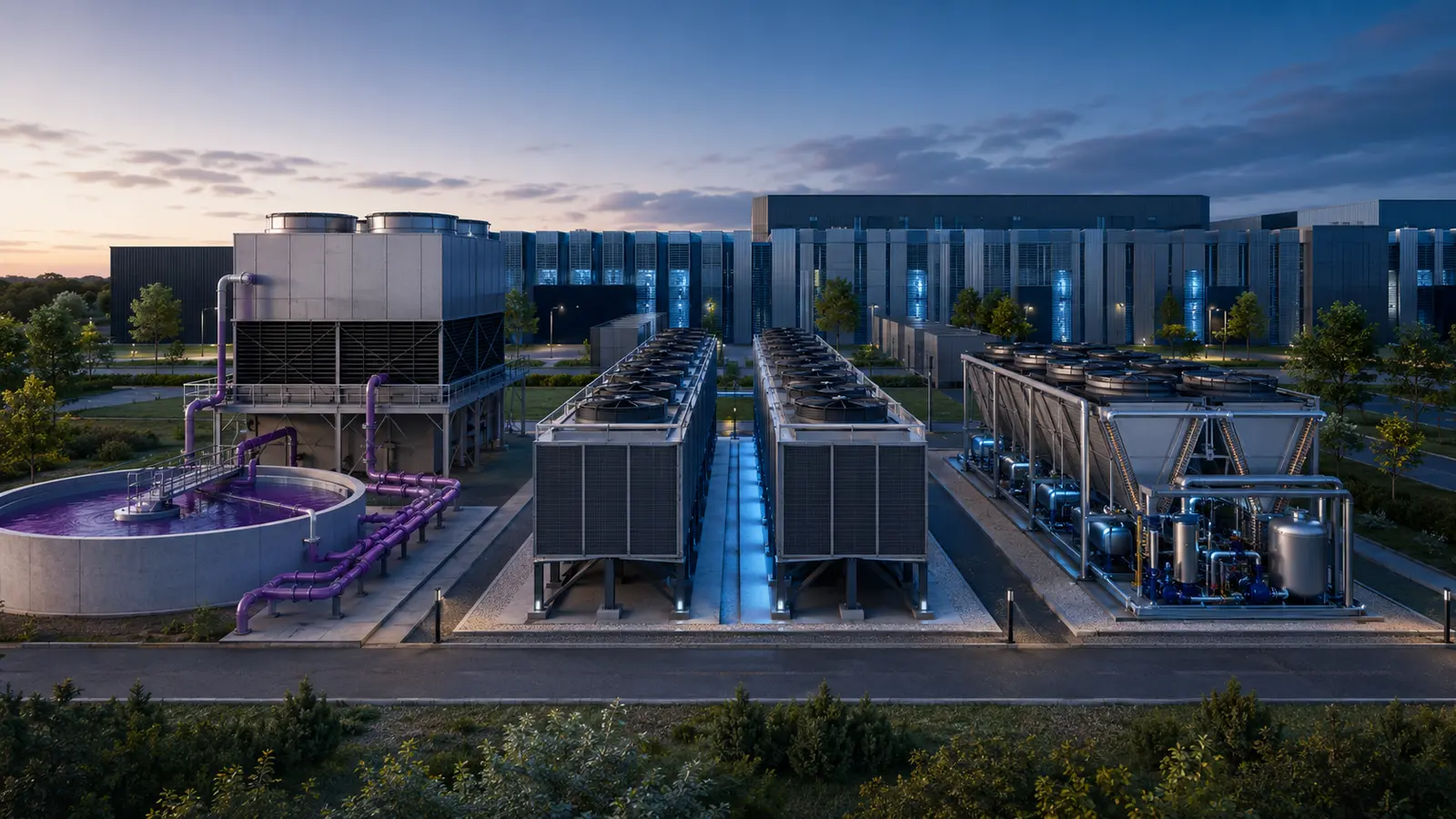
Water efficiency cannot be considered separately from energy efficiency. Evaporative cooling may save electricity at the cost of consuming water. Dry cooling lowers on-site water use but may draw more electricity in hot weather. The right design depends on the local climate, power grid, and level of water stress—not on one target applied to every facility.
What information should operators disclose?
Water Usage Effectiveness, or WUE, compares water consumed during operation with the electricity used by IT equipment. The current ISO/IEC 30134-9:2022 standard defines how the metric is calculated. WUE helps compare intensity, but an average value does not reveal the absolute volume, the source of the water, or local scarcity.
A useful report should answer at least the following questions:
- How much water was withdrawn, and how much was actually consumed?
- Was it drinking water, non-potable water, or reclaimed wastewater?
- Which watershed supplied it, and how vulnerable is that watershed?
- How does consumption change by season?
- What happens during a drought or water-supply failure?
- What indirect water footprint is associated with local electricity?
- Has an independent auditor checked the figures?
A promise to become “water positive” also needs context. Restoring wetlands or funding water projects may be valuable, but it does not automatically return water to the same community on the same hot day when a data center used it.
Disclosure is gradually becoming more than a voluntary practice. Under the EU’s common data-center rating scheme, facilities with an installed IT power demand of at least 500 kW must report annually using harmonized indicators that include water use. Reporting does not solve the problem by itself, but it gives communities and researchers evidence with which to assess operators’ claims.
What can an ordinary user do?
Most people cannot calculate the water footprint of their own prompts. Providers do not disclose where every request was processed or which cooling system served it. A more practical step is to check whether a service publishes site- or region-level information and explains how its facilities operate during water shortages.
Business customers can request these figures when choosing a cloud provider. Cities can make them part of planning and construction approvals. Readers can distinguish measurable reporting from a striking slogan—and should not assume that running a model locally is automatically green. Local use moves the workload to different hardware and a different power grid; it does not make the workload disappear.
What should we ask instead of “How much water did my prompt use?”
Data-center water use is a real infrastructure issue, but it is not identical at every facility. A center in a cool region using treated wastewater and a complex in a dry area connected to a drinking-water network cannot be judged by the same corporate average.
A more useful question for an operator is: What water do you use, why do you use it here, what changes during a drought, and where can the public verify the answer? Those four answers reveal more about a data center’s responsibility than any comparison with a bottle of water.


Join the conversation
Stay on topic and respect other readers. Your first comment may appear after editorial review.