

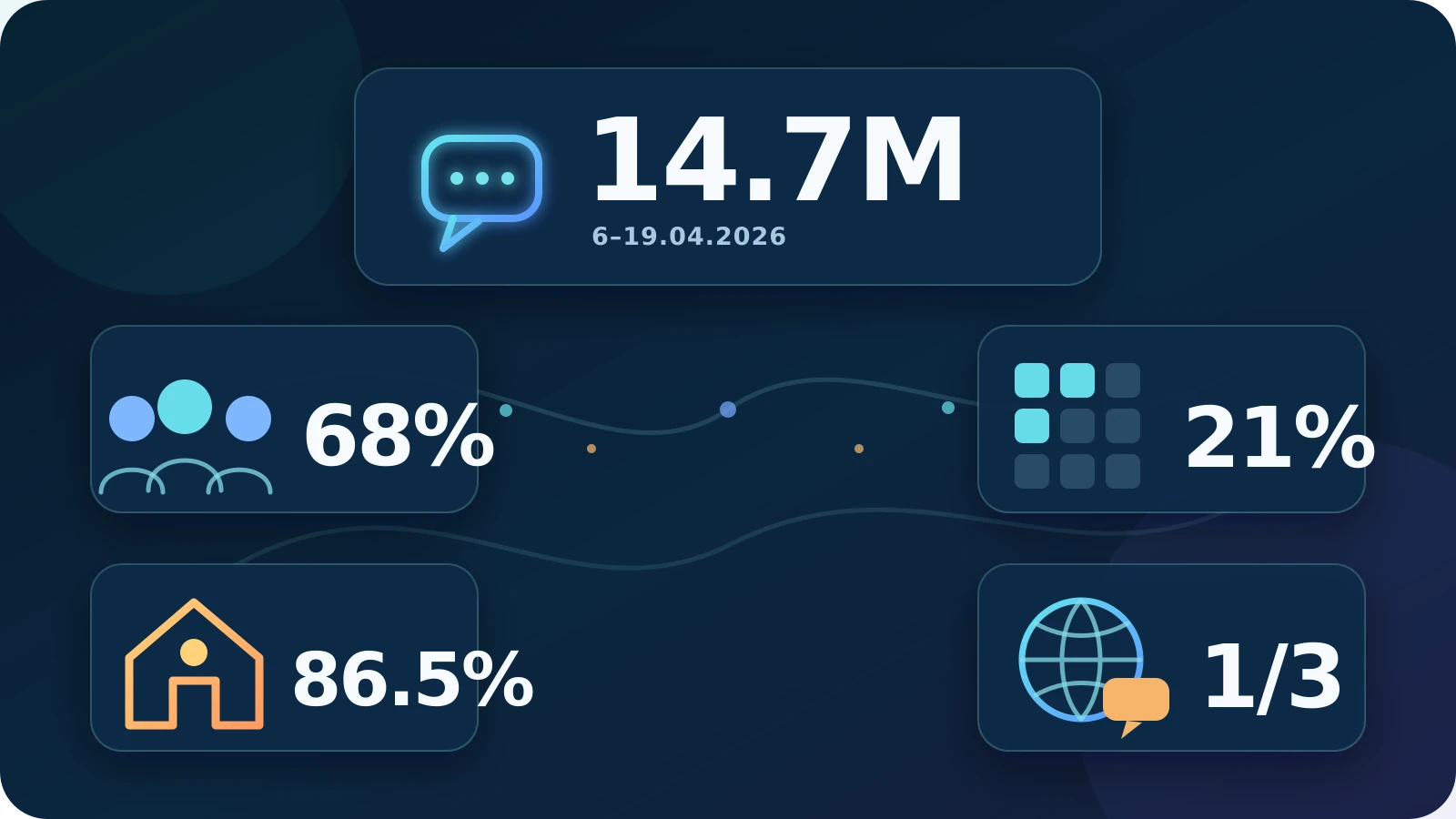
Google analyzed nearly 14.7 million de-identified interactions across the Gemini App, AI Mode, and the Gemini API to examine how people use generative AI at work and at home. The results support neither rapid replacement of most workers nor the idea that AI is useful only to programmers.
The first AI & Economy ATLAS report presents a more complicated picture. Gemini use is visible across many occupations, yet it reaches only part of the task mix inside most of them. People most often ask for information, explanations, ideas, strategy, or help with a draft rather than hand an entire job to the system from beginning to end.
The main Google ATLAS findings
- The final sample contains 14,653,926 interactions collected over two weeks, from April 6 through April 19, 2026.
- Usage exceeded the study’s threshold in 68% of detailed occupations, corresponding to 88.4% of US civilian employment.
- Among occupations where at least one task crossed a separate usage threshold, the median share of such tasks was 21%.
- For non-routine cognitive work, the classifier associated fewer than 10% of interactions with an intent to automate a core task or major subtask end to end.
- 86.5% of conversations in the Gemini App and AI Mode were classified as non-work use; API requests are not included in this figure.
Every number needs a qualifier. This is not a survey of all workers or a measurement of the AI market. ATLAS observed selected Google products, applied privacy thresholds, and classified request intent. It could not see whether a user completed the work after receiving an answer.
What ATLAS actually studied
ATLAS stands for Activity, Task, Landscape, and Adoption Study. According to Google’s overview, the project is intended to become a long-running view of changing AI use. Version 1.0 spans more than 150 countries and territories, about 140 languages, more than 800 occupations, and roughly 4,000 work tasks.
The source surfaces were the Gemini App, AI Mode in Search, and the Gemini API. For the app and AI Mode, the analytical unit was a sequence of messages in a conversation. For the API, it was one request-response pair. Google sampled roughly five million interactions from each surface and then reweighted the results to reflect each surface’s overall share of activity.
Before analysis, the pipeline removed personally identifiable information, replaced internal identifiers with unlinkable UUIDs, created short summaries, and discarded the original text. The interactions were grouped into 550,407 clusters, and clusters representing fewer than ten unique users were removed. Google’s OCTO system and model-based classifiers then mapped those groups to taxonomies for occupations, work tasks, and household activities.
This method offers scale that a survey cannot match, but it does not turn the findings into a precise census. Classification remains probabilistic, short requests and file attachments were excluded, and people who do not use Google’s products are absent.
AI use is broad, but it does not cover the whole job
The clearest finding is the gap between occupational reach and task penetration. Researchers observed meaningful usage in 68% of detailed occupations. An occupation had to have at least 50 unique Gemini users in the global sample to cross that threshold. In the structure of the US labor market, those occupations correspond to 88.4% of civilian employment.
That does not mean 88.4% of workers already use Gemini. The figure describes how much employment is represented by occupations where researchers saw enough activity. Even within those occupations, the system does not touch most duties.
For an individual task, the threshold was at least 25 unique users. Among occupations where one or more tasks crossed it, median “task saturation” was 21%. Occupations with zero task saturation were excluded from that calculation. The defensible conclusion is therefore narrower: use has appeared in many fields, but it remains selective under the study’s own definitions.
Assistance is more common than full automation
Google assigned work interactions to five apparent intents: task automation, partial drafting and generation, review and refinement, ideation and strategy, or information retrieval and learning. In non-routine cognitive work—creative, analytical, and strategic tasks—the classifier labeled fewer than 10% as an attempt to automate the core task or a major subtask end to end.
For routine cognitive work, the share associated with that intent was above one quarter. The distinction is intuitive: a structured data transformation or standard document is easier to delegate fully than a strategy or a decision with ambiguous consequences.
ATLAS still measures the wording of an interaction, not the final result. The researchers could not observe whether the user accepted the answer, saved time, had to redo the work, or retained responsibility for the decision. The under-10% finding therefore does not prove that the same percentage of tasks was actually automated.
Technical and physical occupations use Gemini too
The data complicates the idea that conversational AI belongs only in office work. Automotive technicians, industrial machinery mechanics, and repair specialists used it to interpret test results, troubleshoot wiring, analyze error messages, and inspect equipment for wear.
Multimodal interactions in these occupations appeared at more than twice the overall work baseline. A worker can show the system a component, diagram, or instrument reading and request an explanation, but the physical action, safety check, and accountability still remain with a person.
This fits the broader principle discussed in our guide to how artificial intelligence works: a model can find statistically useful relationships in its input without automatically possessing the complete context of a real-world situation.
Most conversations are not about work at all
In the conversational-product sample—the Gemini App and AI Mode, excluding the API—86.5% of interactions were classified as non-work. People used AI for education, researching purchases, household tasks, explaining instructions, and navigating high-friction administrative processes such as taxes, licensing, and fines.
That activity can reduce the time and stress associated with everyday tasks while remaining largely invisible in company productivity figures or GDP. The report did not, however, measure advice quality. For medical, legal, or financial questions, a convenient 24-hour answer does not remove the need to verify information or consult a qualified professional.
English is only about one third of the conversational sample
ATLAS covered 143 languages that cleared the privacy thresholds. English accounted for just over one third of conversations in the Gemini App and AI Mode. Researchers did not find a systematic shift to English for more complex work: users generally continued to communicate in their primary language.
Per-capita usage nevertheless tended to rise with a country’s GDP. That pattern may indicate a digital divide in access to devices, connectivity, paid capabilities, and skills, although several middle-income countries showed more activity than wealth alone would predict.
What this study does not prove
- It is not the entire AI market. The sample covers the Gemini App, AI Mode, and part of the Gemini API—not ChatGPT, Claude, local models, or other services.
- It is a short snapshot. The data covers only two weeks in April 2026 while both user behavior and model capabilities are changing quickly.
- Professional use may be understated. The main taxonomized sample excludes paid Gemini API activity, Vertex AI, Google Cloud enterprise content, Workspace, and several other products.
- Intent is not an outcome. The classifier estimated what an interaction was about but did not measure productivity, accuracy, time savings, or successful task completion.
- Occupational coverage is not worker adoption. Thresholds show where the global sample contained enough users, not the percentage of people in an occupation who use AI.
What the findings mean for users and businesses
The strongest ATLAS conclusion is neither “AI will take the jobs” nor “AI changes nothing.” At this stage, Gemini is usually inserted into part of a process: finding information, explaining a problem, generating options, producing a first draft, or reviewing a result.
For a team, the practical starting point is to identify repeatable, verifiable tasks and then choose a tool and a quality metric. Our guide to the best AI tools for work can help match a use case to a service, but the workflow still needs fact-checking, data-access rules, and a person accountable for the final output.
ATLAS is valuable because it replaces part of the speculation with observed behavior. Yet even nearly 14.7 million interactions cannot speak for every AI user. It is a large and useful map of one ecosystem segment, offering clear signals of broad diffusion, selective application, and assistance that remains more common than full delegation.




Join the conversation
Stay on topic and respect other readers. Your first comment may appear after editorial review.