
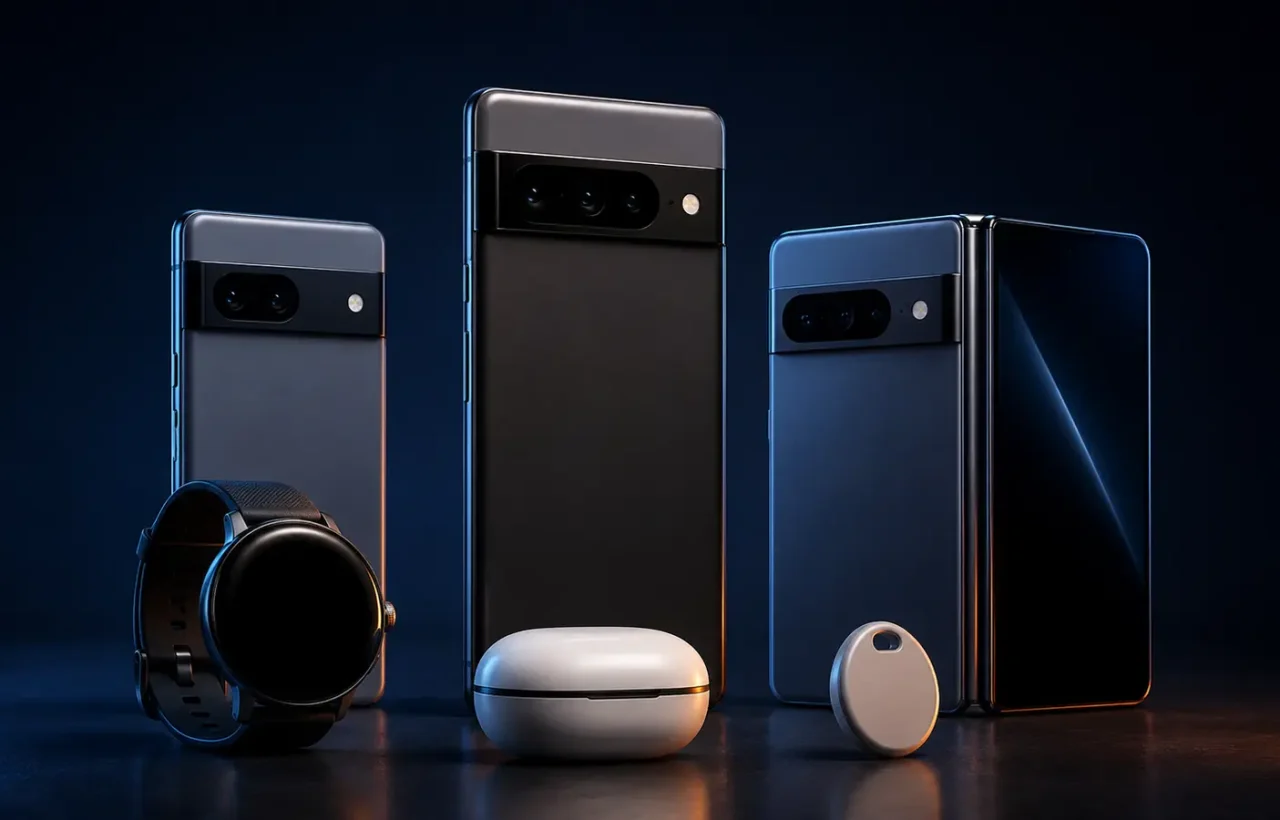
Google has unveiled four Pixel 11 phones, Pixel Watch 5 and its first Pixel Tag tracker. The phones and watch reach shelves on August 20, while Pixel Tag arrives November 11. US pricing starts at $899 for Pixel 11, $1,099 for Pro, $1,299 for Pro XL and $1,899 for the Fold before any trade-in credit.
The generational change is less about a single headline feature and more about a shared platform: Tensor G6, Android 17, at least 256GB of storage, Pixelsnap magnetic charging and seven years of updates. Here is what the confirmed specifications say, where Google is relying on internal claims, and why some buyers should wait for independent tests.
The Pixel 11 lineup at a glance
| Model | Display | Memory | Rear cameras | Battery | US price |
|---|---|---|---|---|---|
| Pixel 11 | 6.3″, 60–120Hz | 12GB; 256/512GB | 48 + 13 + 10.8MP, 5× | 4,985mAh | from $899 |
| Pixel 11 Pro | 6.3″, 1–120Hz | 12/16GB; 256GB–1TB | 50 + 48 + 48MP, 5× | 4,850mAh | from $1,099 |
| Pixel 11 Pro XL | 6.8″, 1–120Hz | 12/16GB; 256GB–1TB | 50 + 48 + 48MP, 5× | 5,115mAh | from $1,299 |
| Pixel 11 Pro Fold | 6.5″ outer / 8″ inner | 16GB; 256GB–1TB | 48 + 10.5 + 10.8MP, 5× | 4,806mAh | $1,899 |
These are launch-day US prices and official specifications. Taxes, storage configurations, trade-in offers, local prices and sales channels vary by market. If you import a device, check warranty coverage, eSIM and carrier support, repairs, and regional feature availability separately.
Pixel 11, Pro or XL: the differences that matter
Pixel 11 has a 6.3-inch display, 12GB of RAM and a dedicated 5× telephoto camera. That is more consequential than the design refresh: the base phone no longer depends entirely on digital zoom for distant subjects. Google also says the camera bar is 40% thinner, although a company measurement is not a substitute for hands-on comfort and repairability tests.
Pro and Pro XL add brighter LTPO displays rated up to 3,600 nits, three higher-resolution cameras and longer digital zoom. Between the two Pro models, the practical choice is size and battery: 6.3 inches and 4,850mAh versus 6.8 inches and 5,115mAh. Pro XL is not automatically the better phone if a compact body matters more than maximum endurance.
Tensor G6 and Gemini without the marketing fog
All four phones use Tensor G6, Titan M3 and Android 17. Google says its new TPU runs AI workloads faster and more efficiently, while Gemini Nano handles some features on-device. Those performance numbers come from internal tests on pre-production hardware; post-launch reviews will tell us more about sustained speed, heat and battery use.
Google promises seven years of OS, security and Pixel Drop updates. That supports a long ownership cycle, but AI features should not be treated as a permanently universal part of the purchase: availability can depend on country, language, age, connectivity and, in some cases, a paid subscription.
Pixel 11 Pro Fold: lighter body and a gentler crease
Pixel 11 Pro Fold is almost 10% lighter and roughly 1mm thinner than its predecessor. Its 6.5-inch outer and 8-inch inner displays both peak at 3,600 nits. It includes 16GB of RAM, Qi2.2 charging up to 25W and wired charging to about 50% in 30 minutes.
The claim of three-times-greater durability is based on Google’s internal testing; it does not mean three times fewer real-world failures. For a foldable, long-term hinge and inner-screen testing, warranty terms and repair pricing remain essential.
Pixel Watch 5 and Pixel Tag
Pixel Watch 5 starts at $399 in 41mm and $429 in 45mm. Google rates the two sizes for up to 30 and 40 hours respectively with the always-on display enabled, and lists a 3,000-nit display, Snapdragon W5 Gen 2 and improved GPS. Some Health Guardian and emergency features are region-limited and are not medical diagnoses, so check country-level availability before buying.
Pixel Tag is Google’s first own tracker for Find Hub. It offers IP67 protection, a user-replaceable battery rated for about a year, UWB precision finding with a compatible Android phone, a reverse phone-ringing button and sharing with up to ten people. It costs $29 individually or $99 for four and goes on sale November 11.
Who should upgrade—and who should wait
- Pixel 8 or older: Pixel 11 may be a meaningful step through longer support, a telephoto camera on the base model and newer batteries, but wait for endurance tests.
- Pixel 9 or Pixel 10: specifications alone do not make annual upgrading necessary. Compare cameras, Tensor G6 thermals and your current battery health first.
- You want a compact flagship: Pixel 11 Pro brings the Pro cameras without an XL body; the base Pixel 11 costs less and now includes a 5× telephoto.
- You are considering the Fold: lower weight helps, but the $1,899 price and complex hardware make independent reviews and local warranty support mandatory checks.
- You are buying outside an official market: verify carrier support, warranty, repairs, AI and emergency features before payment, not after delivery.
Bottom line
Pixel 11 is a mature lineup update, not a reason to buy on announcement day. Google has aligned the base and Pro phones on minimum storage, added a telephoto to Pixel 11, made the Fold lighter and expanded the ecosystem with a watch and tracker. The big unknowns are real battery life, thermals, camera quality and feature availability in each market. Those are worth checking once retail testing begins after August 20.




Join the conversation
Stay on topic and respect other readers. Your first comment may appear after editorial review.